
The best dental marketing ideas in 2026 focus on helping dental practices attract local patients, build trust, increase appointment bookings, and improve patient retention. These strategies include local SEO, Google Business Profile optimization, dental ads, online reviews, content marketing, referral systems, and conversion improvements.
This guide covers 30 practical dental marketing ideas that practices can use to improve visibility, generate more qualified inquiries, and turn website visitors into booked patients.
What Is Dental Marketing?
Dental marketing is the process of helping suitable patients discover a practice, trust its team, book care, return for future treatment, and recommend it to others.
Successful marketing dentistry depends heavily on location, reputation, patient comfort, professional credibility, and treatment value. Someone seeking an emergency dentist has a different intent from a patient comparing veneers, orthodontic treatment, or dental implants.
Effective dental marketing therefore includes both:
- External marketing: SEO, Google Ads, social media, community outreach, and professional referrals
- Internal marketing: recall reminders, patient communication, treatment follow-up, reviews, and referral programs
A practice needs both sides. Attracting new patients becomes expensive when existing patients are not returning or completing recommended treatment.
How Do Dental Marketing Ideas Help Attract and Convert Patients?
Effective dental marketing ideas work together across five areas: attracting new patients, building trust, increasing appointment bookings, keeping existing patients active, and encouraging referrals. A practice should first identify where patients are being lost before investing more budget into new campaigns.
| Stage | Patient question | Marketing priority |
|---|---|---|
| Visibility | Can I find this practice? | Search, Maps, ads, and social media |
| Trust | Can I trust this dentist? | Reviews, credentials, and content |
| Conversion | Is booking easy? | Landing pages, calls, and online booking |
| Retention | Should I return? | Recall and patient communication |
| Referral | Would I recommend them? | Reviews and referral systems |
Most dental practices invest heavily in visibility but pay less attention to missed calls, inactive patients, abandoned forms, and unaccepted treatment plans. Those gaps should be fixed before increasing advertising spend.
For example, suppose an advertising campaign generates 40 calls, but only 25 are answered and 10 become appointments. In that situation, the main problem may not be visibility. Improving call handling could produce more bookings without increasing ad spend.
Stage 1: Increase Local Visibility
How Can More Patients Find Your Dental Practice?
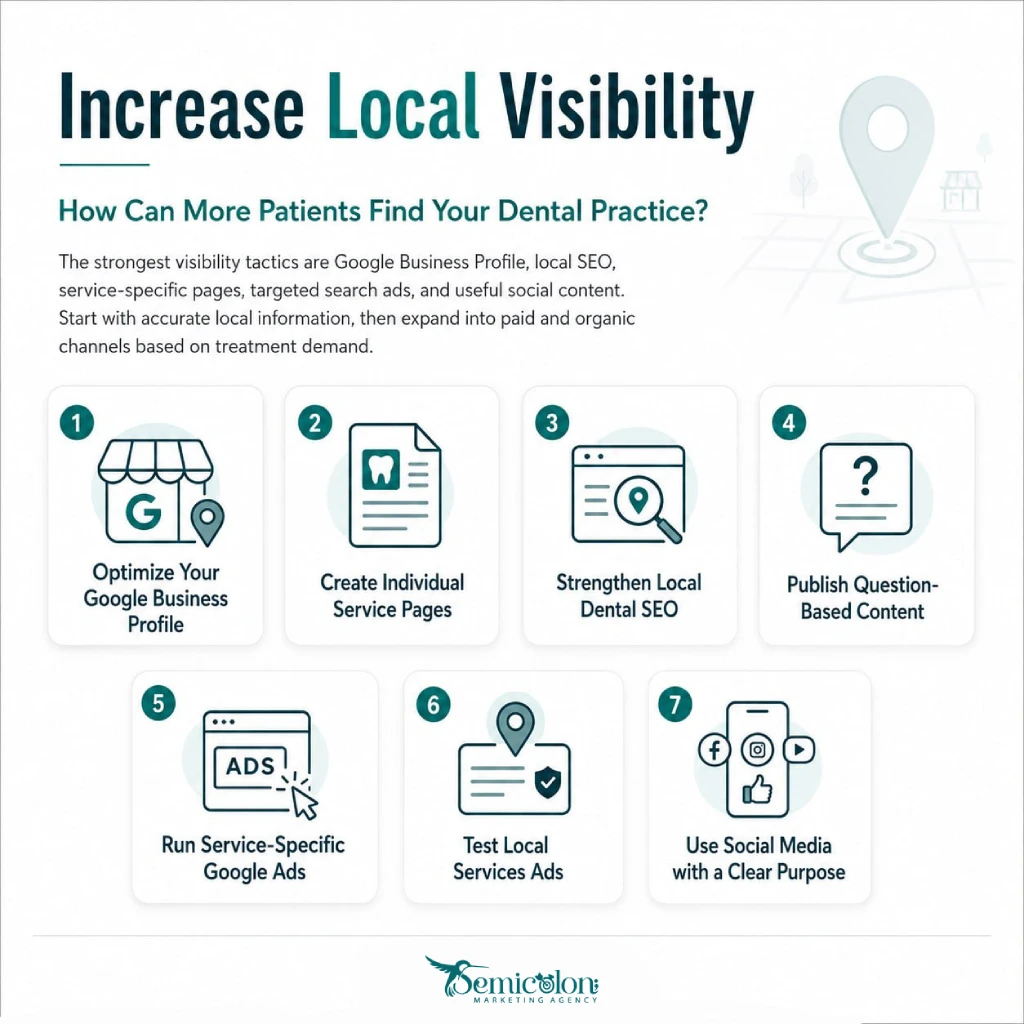
The strongest visibility tactics are Google Business Profile, local SEO, service-specific pages, targeted search ads, and useful social content. Start with accurate local information, then expand into paid and organic channels based on treatment demand.
-
Optimize Your Google Business Profile
Complete your address, phone number, categories, treatments, opening hours, photographs, and booking link. Google explains that local visibility is influenced by relevance, distance, and prominence.
Review the official Google Business Profile guidelines before editing your listing.
-
Create Individual Service Pages
Build a focused page for each important treatment, such as:
- Emergency dentistry
- Dental implants
- Teeth whitening
- Pediatric dentistry
- Invisalign
- Root canal treatment
A dedicated page is more useful to both patients and search engines than a general list of services.
-
Strengthen Local Dental SEO
Use consistent contact information, clear location signals, internal links, original photographs, and locally relevant information.
Your [Dental SEO Services] page can support this section by explaining the technical and local ranking process in greater detail.
-
Publish Question-Based Content
Create articles around questions real patients ask, such as:
- How long do dental implants last?
- Is professional teeth whitening safe?
- When should children first visit a dentist?
- What affects the cost of Invisalign?
Start each article with a direct answer. Google recommends creating helpful, reliable, people-first content rather than publishing pages mainly to target search terms.
-
Run Service-Specific Google Ads
Separate campaigns by treatment, location, and search intent. An emergency patient should not see the same message or landing page as someone researching cosmetic dentistry.
Relevant internal resources can include [Dental Clinic for Google Ads] and [Dental Google Ads Keywords].
-
Test Local Services Ads
Google Local Services Ads may allow eligible practices to receive calls or messages directly from search results. Availability and verification rules vary by market.
Check the official Google Local Services Ads documentation.
-
Use Social Media with a Clear Purpose
Share dentist-led videos, team introductions, treatment explanations, oral care tips, and office updates. Cosmetic practices may benefit from visual platforms, while family and pediatric practices may gain more from parent-focused content and community engagement.
Stage 2: Build Patient Trust
How Can a Dental Practice Build Trust Online?
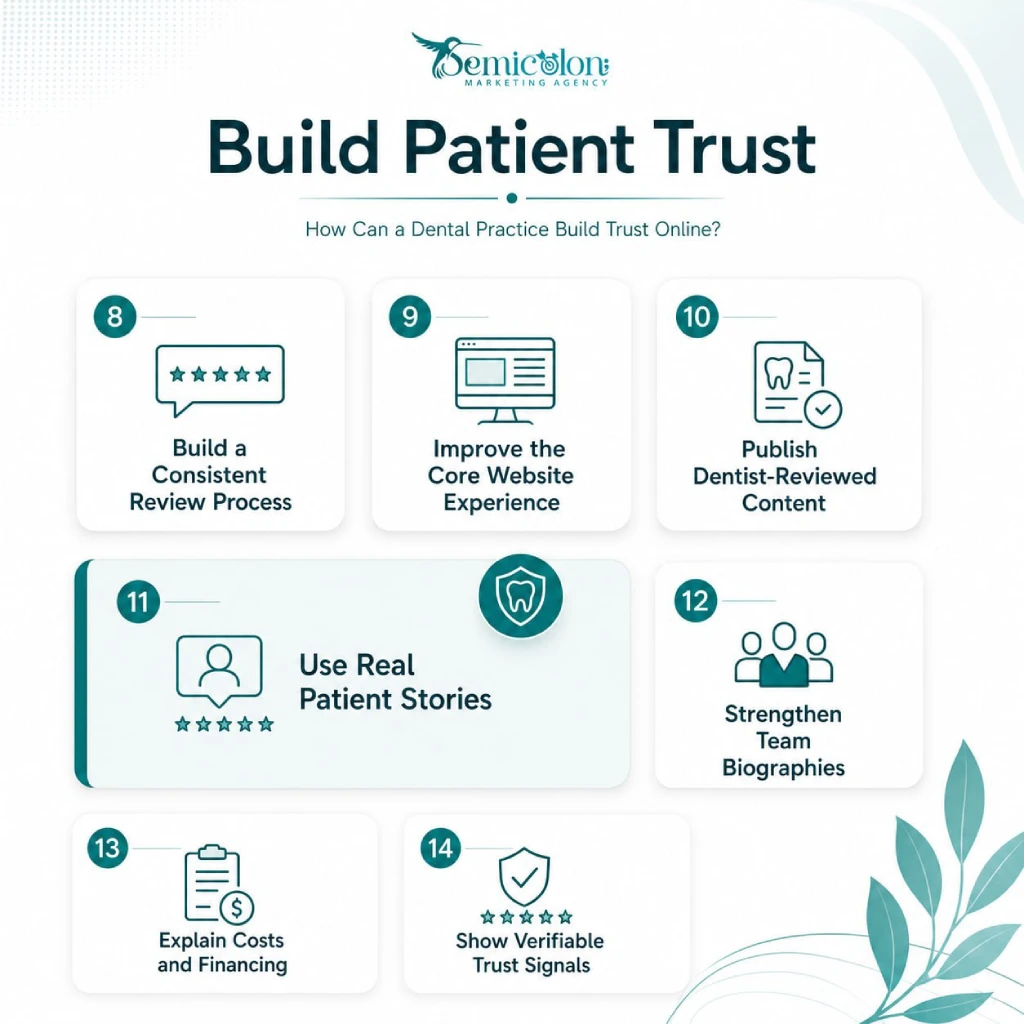
Dental practices build trust online by showing credibility, transparency, and real patient value. Reviews, dentist profiles, educational content, clear treatment information, and authentic patient experiences help potential patients feel confident before booking an appointment.
8. Build a Consistent Review Process
Send a polite review request after suitable appointments. Ask for honest feedback rather than specifically requesting a positive review.
The ADA recommends protecting patient privacy when responding publicly. Read its guidance on legal and ethical online reviews.
9. Improve the Core Website Experience
Your website should quickly answer four questions:
- What treatments do you provide?
- Who provides the care?
- Where are you located?
- How can a patient book?
A strong [Dental Web Design] page can explain how page speed, mobile usability, navigation, and trust elements affect conversion.
10. Publish Dentist-Reviewed Content
Show the author or clinical reviewer, professional title, credentials, and last review date. Important medical or statistical claims should link to reliable sources.
11. Use Real Patient Stories
With written permission, describe the patient’s concern, available options, treatment process, and general outcome. Avoid promising that every patient will receive the same result.
12. Strengthen Team Biographies
Useful biographies can include clinical interests, training, treatment philosophy, languages spoken, and experience helping anxious patients.
13. Explain Costs and Financing
When exact fees vary, explain what affects the final cost, what the consultation includes, and which payment or financing options may be available.
14. Show Verifiable Trust Signals
Relevant qualifications, memberships, awards, and media coverage can support credibility. Avoid vague claims such as “the best dentist” unless they are objectively supportable.
Stage 3: Convert Interest into Appointments
How Can You Turn Website Visitors into Booked Appointments?
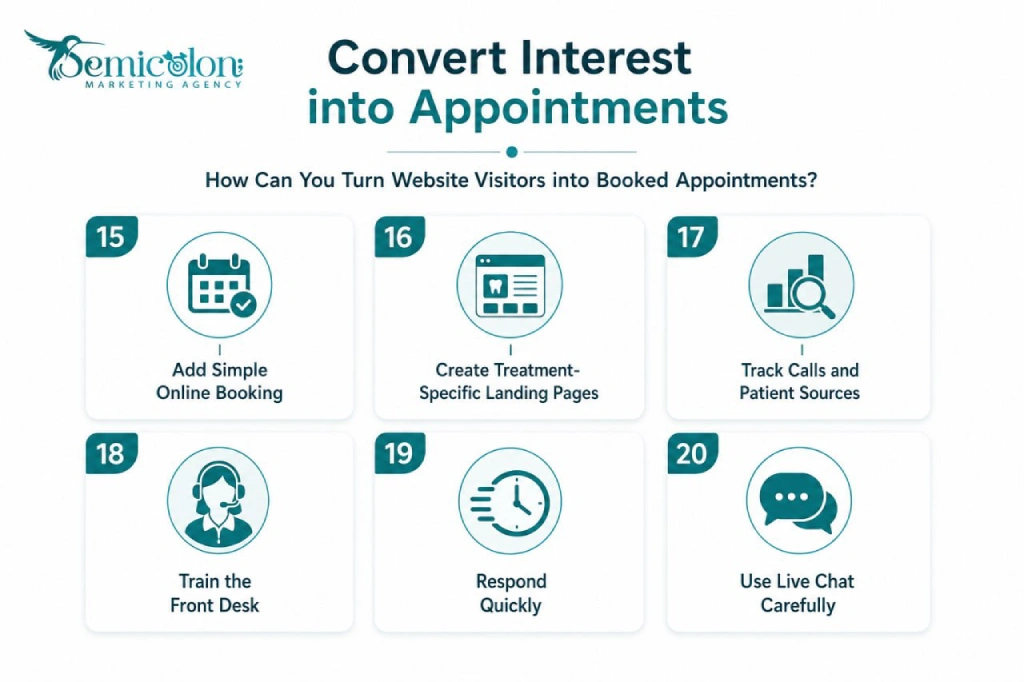
Patients are more likely to book when the next step is obvious, the response is fast, and the page matches the treatment they searched for.
15. Add Simple Online Booking
Keep the booking form short. Explain whether the appointment is confirmed immediately or requires staff approval.
16. Create Treatment-Specific Landing Pages
A dental implant advertisement should lead to a focused implant page, not the homepage.
A useful landing page includes treatment information, dentist credentials, FAQs, financing details, and one clear booking action. See [Landing Page Dentist] for a deeper conversion framework.
17. Track Calls and Patient Sources
Record:
- Where the inquiry came from
- Which treatment was requested
- Whether an appointment was booked
- Why the patient did not book
- Whether follow-up is needed
18. Train the Front Desk
Reception staff should confidently handle emergency inquiries, cost questions, nervous patients, insurance concerns, and missed-call follow-up.
19. Respond Quickly
Patients often contact several practices. Automated confirmation is helpful, but a personal response should follow as soon as reasonably possible.
20. Use Live Chat Carefully
Chat can answer basic questions about treatments, location, hours, and appointment availability. It should not diagnose conditions or request unnecessary private health information.
Stage 4: Improve Patient Retention
How Can Dental Practices Keep Patients Active?
Dental practices retain more patients when reminders are reliable, communication is useful, and delayed treatment receives respectful follow-up.
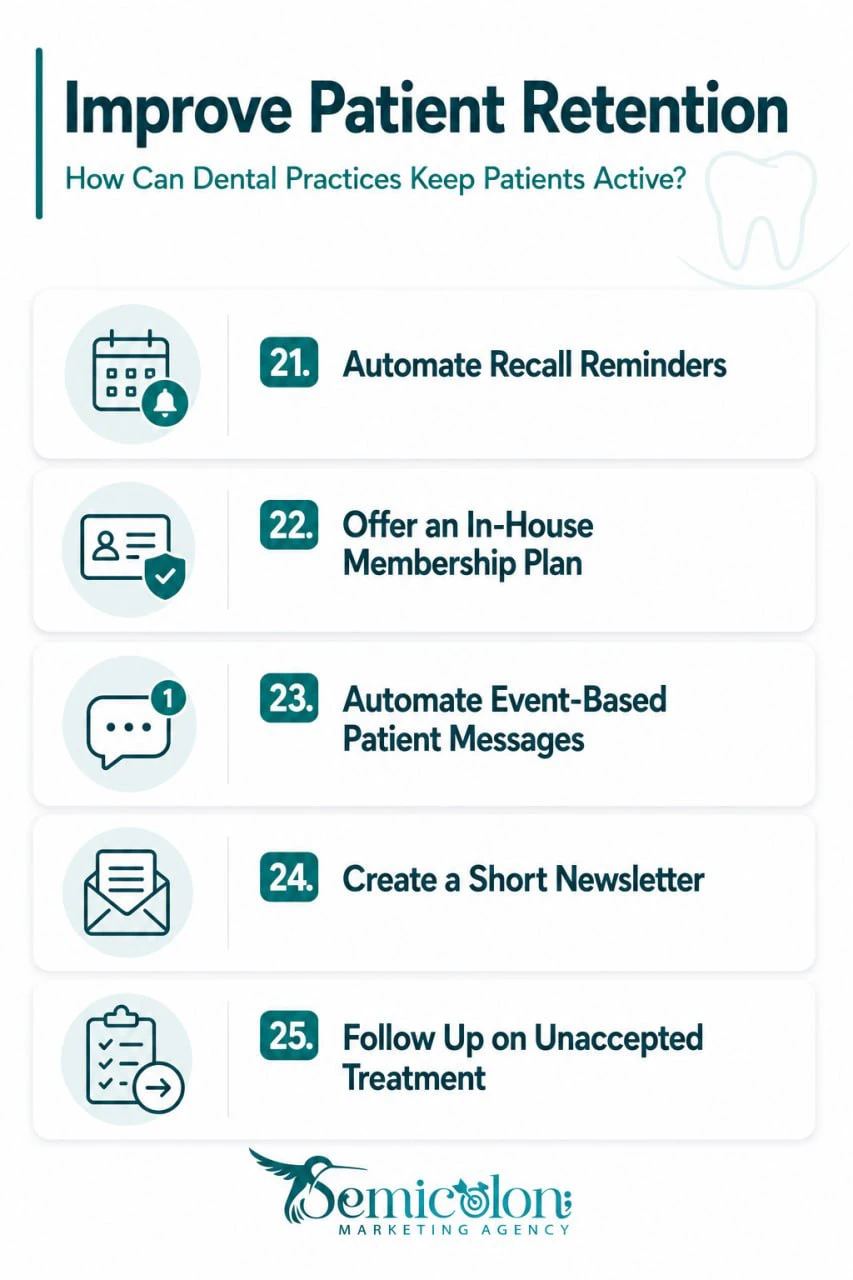
21. Automate Recall Reminders
Make it easy for patients to confirm or reschedule examinations, hygiene visits, and continuing treatment.
22. Offer an In-House Membership Plan
Clearly explain inclusions, exclusions, payment terms, discounts, and cancellation conditions. Do not present a membership plan as insurance.
23. Automate Event-Based Patient Messages
Send messages when a specific patient action requires them, such as appointment confirmation, post-treatment care, recall, an incomplete booking, or delayed treatment. Each message should help the patient take one clear next step.
24. Create a Short Newsletter
A concise monthly or quarterly newsletter can keep the practice familiar while educating patients.
25. Follow Up on Unaccepted Treatment
A patient may delay treatment because of cost, timing, anxiety, or unanswered questions. Follow-up should clarify the plan and support informed decision-making, not create pressure.
Stage 5: Generate More Referrals
How Can You Turn Patients into Advocates?
Patient referrals grow when people receive a positive experience and have a simple, ethical way to recommend the practice.
26. Create a Clear Referral Process
Explain how patients can introduce friends or family. Any reward or credit should comply with local advertising and professional rules.
27. Build Professional Referral Relationships
Develop reliable communication with orthodontists, oral surgeons, endodontists, pediatric dentists, physicians, and other healthcare providers.
28. Create Shareable Patient Moments
Treatment milestones may encourage patients to share their experience. Obtain appropriate consent before publishing or reposting identifiable content.
29. Recognize Loyal Patients
Convenient scheduling, personalized follow-up, consistent care, and thoughtful communication often create stronger loyalty than discounts.
30. Participate in the Local Community
Support schools, charities, sports teams, and health initiatives where the practice can provide genuine value rather than simply display its logo.
What Are the Most Effective Dental Marketing Ideas in 2026?
The most effective dental marketing ideas combine local search visibility, patient trust signals, conversion optimization, retention systems, and referral strategies. The right approach depends on the practice’s goals, location, specialty, and current marketing gaps.
| Marketing Goal | Practical answer |
|---|---|
| Best channel for local discovery | Google Business Profile and local SEO |
| Fastest way to generate inquiries | Targeted Google Ads |
| Best long-term strategy | SEO, reviews, and helpful content |
| Most overlooked opportunity | Patient retention and referrals |
| Most important metric | Cost per new patient |
| Best place to start | Fix tracking and conversion leaks |
How Should Dental Marketing Change by Specialty?
General dentistry often benefits from local SEO, reviews, and recall systems, while cosmetic, pediatric, orthodontic, implant, and endodontic practices may require different combinations of channels depending on location, competition, budget, and patient behavior.
| Specialty | Main channel | Best content focus |
|---|---|---|
| General dentistry | Local SEO and Google Maps | Prevention, family care, and recall |
| Cosmetic dentistry | Instagram and Google Ads | Visual results and consultation |
| Pediatric dentistry | Parent-focused social content | Comfort, safety, and first visits |
| Orthodontics | Search ads and retargeting | Options, timing, and financing |
| Dental implants | Google Ads, SEO, and education | Candidacy, process, recovery, and costs |
| Endodontics | Professional referrals | Symptoms, urgency, and treatment process |
Supporting pages such as Dental Implant Ads and Pediatric Dental Marketing should provide a deeper strategy for those specialties.
How Much Should a Dental Practice Spend on Marketing?
There is no fixed marketing percentage that suits every dental practice. Budget decisions should reflect the practice’s growth stage, local competition, treatment capacity, average case value, and current marketing foundation.
A possible starting allocation is:
| Marketing area | Example allocation |
|---|---|
| Search visibility and advertising | 40% |
| Website, content, and trust assets | 20% |
| Tracking and conversion tools | 15% |
| Retention systems | 15% |
| Referral and community activity | 10% |
This is a planning model, not a universal benchmark. New practices may need more visibility, while established practices may gain more from retention and treatment acceptance.
Agency fees, content production, CRM tools, call tracking, and advertising spend should also be calculated separately.
Which Dental Marketing Metrics Matter Most?
The most useful dental marketing metrics connect spending to qualified inquiries, appointments, and patient revenue.
| Metric | What it measures |
|---|---|
| Cost per lead | Marketing cost divided by all inquiries |
| Cost per qualified lead | Cost divided by inquiries suitable for the service |
| Cost per new patient | Cost divided by new patients who attend |
| Lead-to-booking rate | Percentage of inquiries that schedule |
| Attendance rate | Percentage of bookings that attend |
| Treatment acceptance | Percentage accepting recommended care |
| Patient retention | Percentage returning for ongoing care |
Clicks and impressions can help diagnose campaign performance, but they should not replace business outcomes. A [Google Ads Conversion Tracking] resource can explain how to connect calls, forms, bookings, and treatments to their original marketing source.
How Can Dentists Prepare for AI Search in 2026?
AI search visibility relies on the same foundations as strong SEO: direct answers, reliable sources, consistent business information, visible authorship, original evidence, and technically accessible pages. Dental practices do not need a separate “AI-only” content system.
Practical steps include:
- Use question-based headings
- Answer the question in the first paragraph
- Identify the author and clinical reviewer
- Add original examples, images, and explanations
- Cite reliable sources
- Keep business information consistent
- Connect related service pages through internal links
- Use appropriate structured data
LocalBusiness structured data may also help search engines understand business details, although it does not guarantee visibility. See Google’s LocalBusiness structured data documentation.
What Compliance Rules Apply to Dental Marketing?
Dental marketing must protect patient information, obtain appropriate consent, and avoid misleading claims. The exact requirements depend on the country, state, province, and professional regulator.
- In the United States, review the official HHS guidance on HIPAA and marketing.
- The ADA also provides guidance on legal and ethical dental advertising.
- Canadian practices should consider federal and provincial requirements. The Office of the Privacy Commissioner of Canada explains the principles of meaningful consent.
Before publishing testimonials, radiographs, photographs, treatment stories, or before-and-after images, obtain appropriate written permission and review the rules that apply to your practice.
What Should a 90-Day Dental Marketing Plan Include?
A practical 90-day plan should fix conversion leaks before expanding promotion.
| Period | Focus | Deliverable | KPI to review |
|---|---|---|---|
| Days 1–30 | Tracking and quick fixes | GBP audit, call tracking, review process, booking audit | Missed-call rate and booking baseline |
| Days 31–60 | Build stronger assets | Service pages, landing pages, content, recall workflows | Page conversion and recall response |
| Days 61–90 | Scale proven channels | Ads, referrals, specialty campaigns | Cost per new patient and treatment acceptance |
The main goal is not to launch everything at once. It is to identify the weakest stage, improve it, and measure the result.
What Are Common Dental Marketing Mistakes?
The most expensive mistakes often happen after a patient clicks:
- Sending every campaign to the homepage
- Publishing generic or duplicated content
- Ignoring Google Business Profile
- Failing to track calls and bookings
- Responding slowly to inquiries
- Using unsupported treatment claims
- Neglecting inactive patients
- Publishing patient information without consent
- Scaling ads before fixing conversion problems
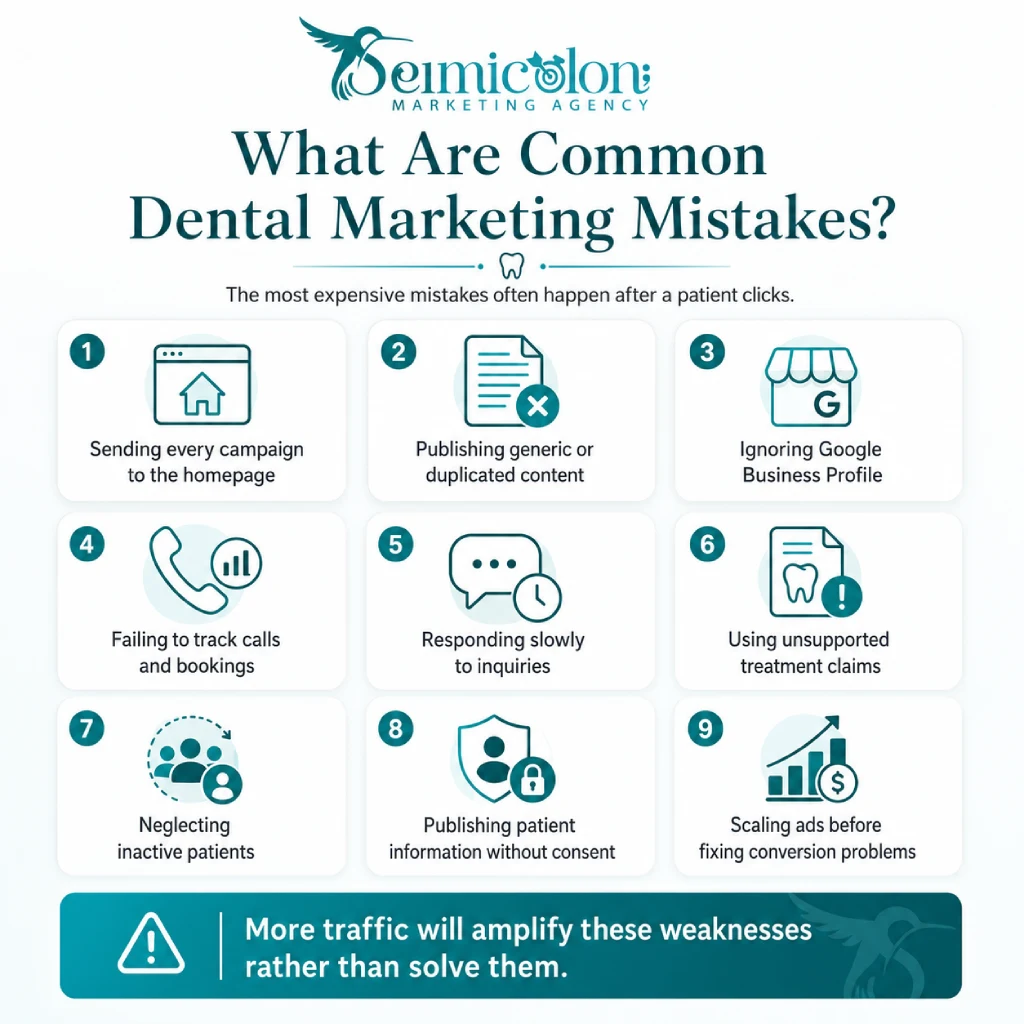
More traffic will amplify these weaknesses rather than solve them.
Where Should Your Practice Start?
Start with one diagnostic question: where do suitable patients leave the journey? If the practice is difficult to find, improve visibility. If inquiries arrive but do not become appointments, review call handling, landing pages, and follow-up. If patients do not return, focus on recall and retention.
A structured dental marketing assessment can identify the weakest stage and turn it into one measurable priority for the next 90 days. The goal is not to launch more tactics; it is to invest in the change most likely to improve patient growth. A dental marketing assessment can help identify the biggest growth opportunity for your practice and create a practical plan based on your current goals, patients, and resources.
FAQs
What is the best dental marketing strategy for a new practice?
Start with Google Business Profile, a clear website, individual service pages, reliable call handling, review collection, and conversion tracking. Add paid advertising after the practice can respond to and measure inquiries properly.
Should dentists invest in SEO or Google Ads?
Most practices benefit from both. Google Ads can create faster visibility, while dental SEO builds long-term organic discovery and reduces dependence on paid traffic.
Which dental marketing channel produces results fastest?
Targeted Google Ads can generate inquiries quickly when campaigns use relevant keywords, local targeting, and dedicated landing pages. Fast traffic does not guarantee appointments unless follow-up and call handling are strong.
How much should a dentist spend on marketing?
The right budget depends on growth goals, competition, practice capacity, and patient value. New practices may invest more in visibility, while established clinics may benefit more from retention and conversion improvements.
What is a good cost per new dental patient?
There is no universal number. A sustainable cost depends on the patient’s expected treatment value, retention potential, and the practice’s profit margin. Cost per new patient should always be compared with patient lifetime value.
How do you measure dental marketing ROI?
Track the total marketing cost, qualified inquiries, booked appointments, attended appointments, accepted treatment, and revenue connected to each source. Avoid calculating ROI from clicks or leads alone.
Does social media work for dental practices?
Yes, when the content matches the audience. Social media is especially useful for building familiarity, explaining treatments, showing the practice environment, and supporting cosmetic, pediatric, and community-focused marketing.
How can dentists get more reviews ethically?
Ask suitable patients for honest feedback, keep the process easy, and avoid requesting only positive reviews. Never reveal private patient details when replying publicly.
How long does dental marketing take to show results?
The timeline depends on the strategy. Paid ads can generate visibility quickly, while SEO, content, reviews, and referral systems usually require consistent effort over a longer period.


