
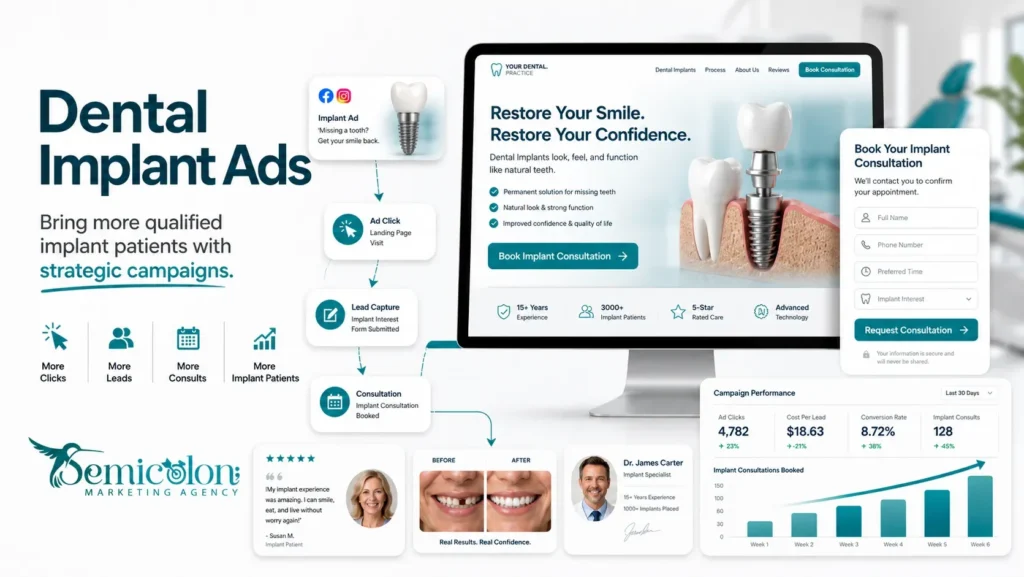
When patients look for dental implant treatments, they rarely browse aimlessly; they search with purpose. They open Google, type “best dental implants near me,” and compare clinics. Well-optimized Google Ads for dental implants position your clinic at that exact decision-making moment, helping you connect with ready-to-book patients, lower your acquisition costs, and achieve measurable, sustainable growth.
What Are Dental Implant Ads and Why Do They Matter?
Dental implant ads are digital campaigns designed to reach people actively searching for implant treatments, one of the highest-value segments in dental care. Instead of generic exposure, Google Ads allows clinics to appear directly in front of users whose search intent is strong: they want a new smile, and they want it soon.
For dental clinics, this is an extraordinary chance. Traditional advertising (such as flyers or billboards) depends on passive visibility, whereas Google Ads involves patients at the very moment they are ready to act. Each click signifies a possible consultation, a lead that can convert more easily than a person reached through offline means.
When done right, dental implant PPC campaigns create a constant flow of high-quality patients, measurable results, and a predictable ROI.
Why Google Ads Are Crucial for Dental Implant Marketing
Dental implants are a premium, trust-based treatment. Patients typically conduct extensive research before choosing a clinic, often comparing options by price, technology, and patient reviews. According to recent marketing studies, over 82% of patients use Google as their primary research tool before booking a consultation.
Unlike other procedures, implant patients aren’t browsing casually; they are in decision mode. That means your ad placement, message, and landing page can determine whether they call you or your competitor.
With Google Ads for dental implants, you can:
- Target patients by location, age, or search behavior.
- Appear when users search “dental implants near me” or “same-day implant clinic.”
- Measure every click, call, and form submission in real time.
- Re-engage visitors who didn’t convert the first time through remarketing.
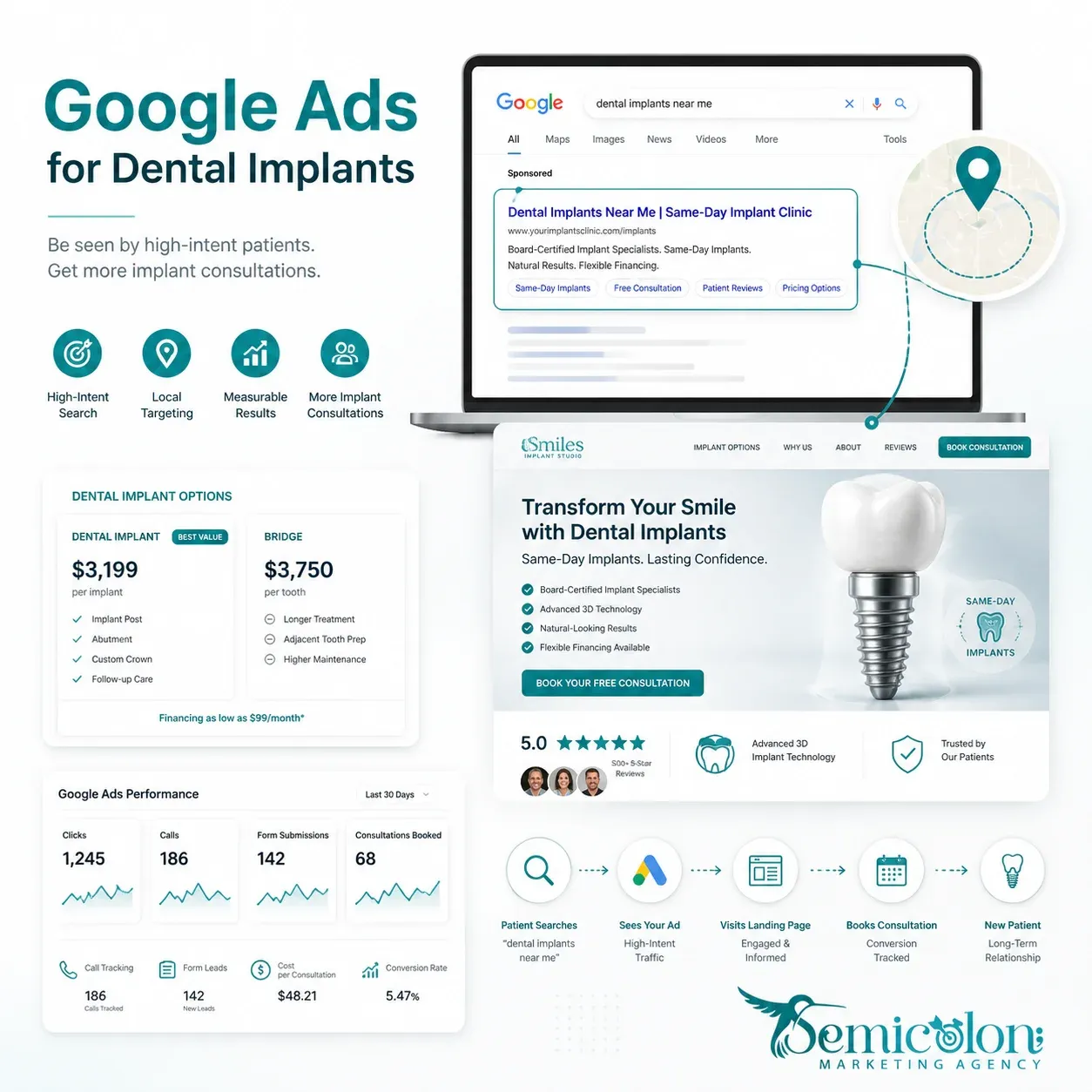
Cost of Dental Implant Ads
Cost is one of the first questions every clinic asks, and this is done correctly. Normally, the average cost per click (CPC) for dental implant ads is between $5 and $15, which varies according to the region, competition for keywords, and the performance of the landing page.
The following reasons can be attributed to the stated price:
- Place: More competition in places with a high population, such as Los Angeles and Toronto.
- Type of Service: The keywords “All-on-4 implants” or “full-mouth restoration” usually cost more than general implant searches.
- Ad Quality & Relevance: Google lowers CPC for relevant, high-quality campaigns.
- Landing Page Experience: If you provide a great user experience (speed, trust, clarity), you end up paying less per click.
While these numbers may seem high, it’s important to remember that dental implant patients have an average lifetime value (LTV) five to ten times higher than general dental patients. This makes PPC investment not only sustainable but extremely profitable when managed correctly.
How to Manage and Reduce Advertising Costs
Running an efficient dental implant PPC campaign isn’t about spending more — it’s about spending smarter.
Here’s how successful clinics maintain strong performance while keeping budgets under control:
- A/B Testing: Continuously test different headlines, ad copy, and CTAs to identify which variations convert best.
- Geo-Targeting: Focus your ads on neighborhoods or zip codes your clinic actually serves.
- Negative Keywords: Exclude irrelevant searches like “free implants” or “implant courses” to avoid wasted clicks.
- Ad Scheduling: Show ads during hours when your front desk can answer calls or respond to messages quickly.
- Performance Monitoring: Use conversion tracking to identify which ads generate real consultations, not just clicks.
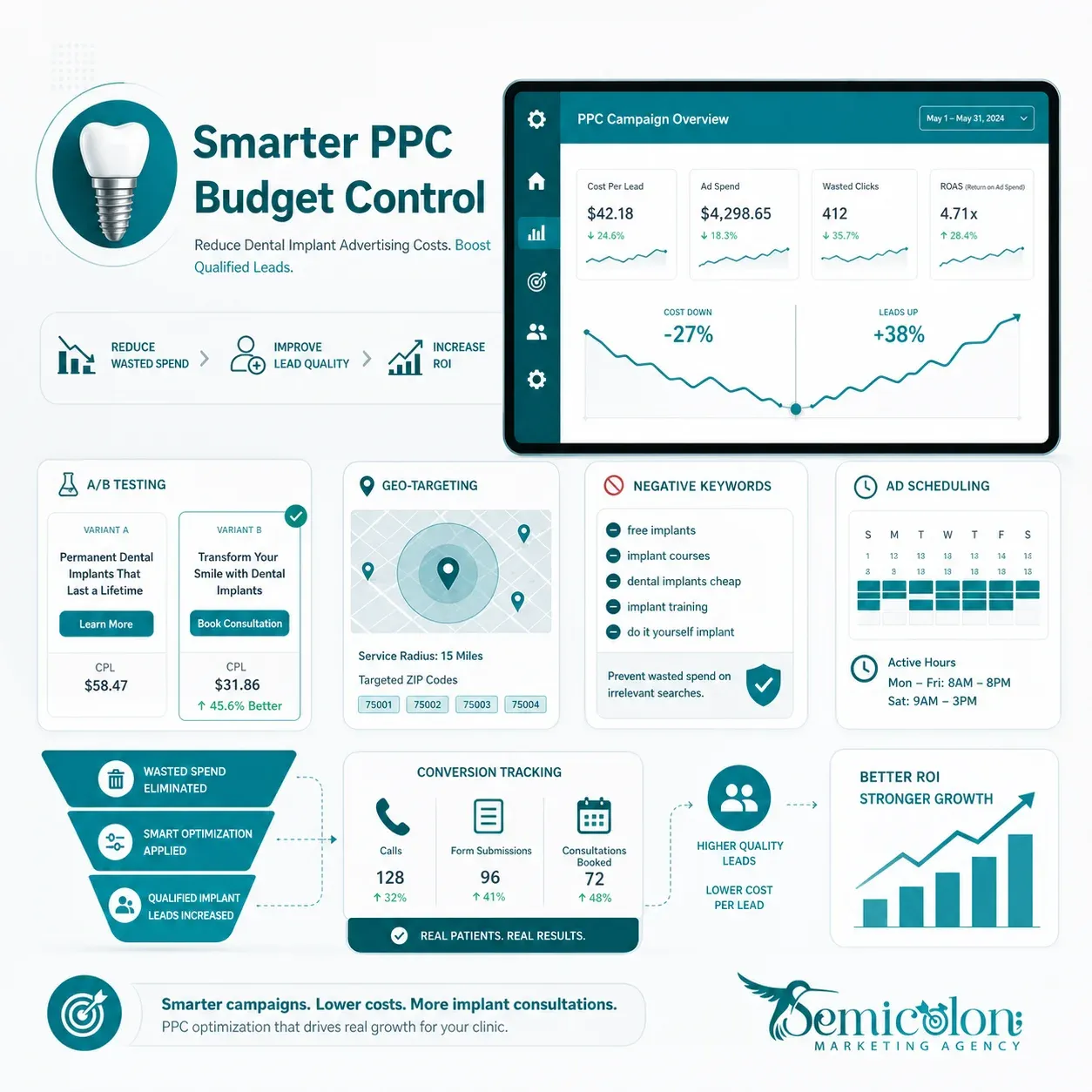
When campaigns are built around data, not assumptions, even small daily budgets can deliver significant lead growth.
What to Expect from a Dental Implant Campaign
A campaign that is optimized correctly not only results in more website visits but also in measurable outcomes. Clinics that are within the 60-90-day period can most likely see.
An easily noticeable increase in the number of calls, appointment bookings, and consultation requests.
A higher number of people are interacting with the clinic’s landing pages and filling out contact forms.
A clearer view of the return on investment through conversion tracking with detailed reporting.
The brand of the clinic is being considered with more authority as the clinic keeps showing up at the top of the local searches.
Over time, as your campaigns collect more data, Google’s algorithms learn which keywords, demographics, and ad messages deliver the best results, continuously improving your cost efficiency and lead quality.
Advantages of Google Ads for Implant Clinics
There’s a reason top-performing dental brands rely on Google Ads: precision, measurability, and immediacy.
The primary benefits consist of:
- Instant Visibility: Be the first to be seen when patients look for “dental implants near me.”
- Precision Targeting: Let’s get to the intended patients based on their location and search intent, right at the right time.
- Retargeting: Get back in touch with those who came to your website yet didn’t make an appointment.
- Transparent Analytics: Keep an eye on every impression, click, and conversion as they are happening.
- Scalability: Go for a small start, then move on to the analysis of the results, and later on, expand once the ROI is applicable.
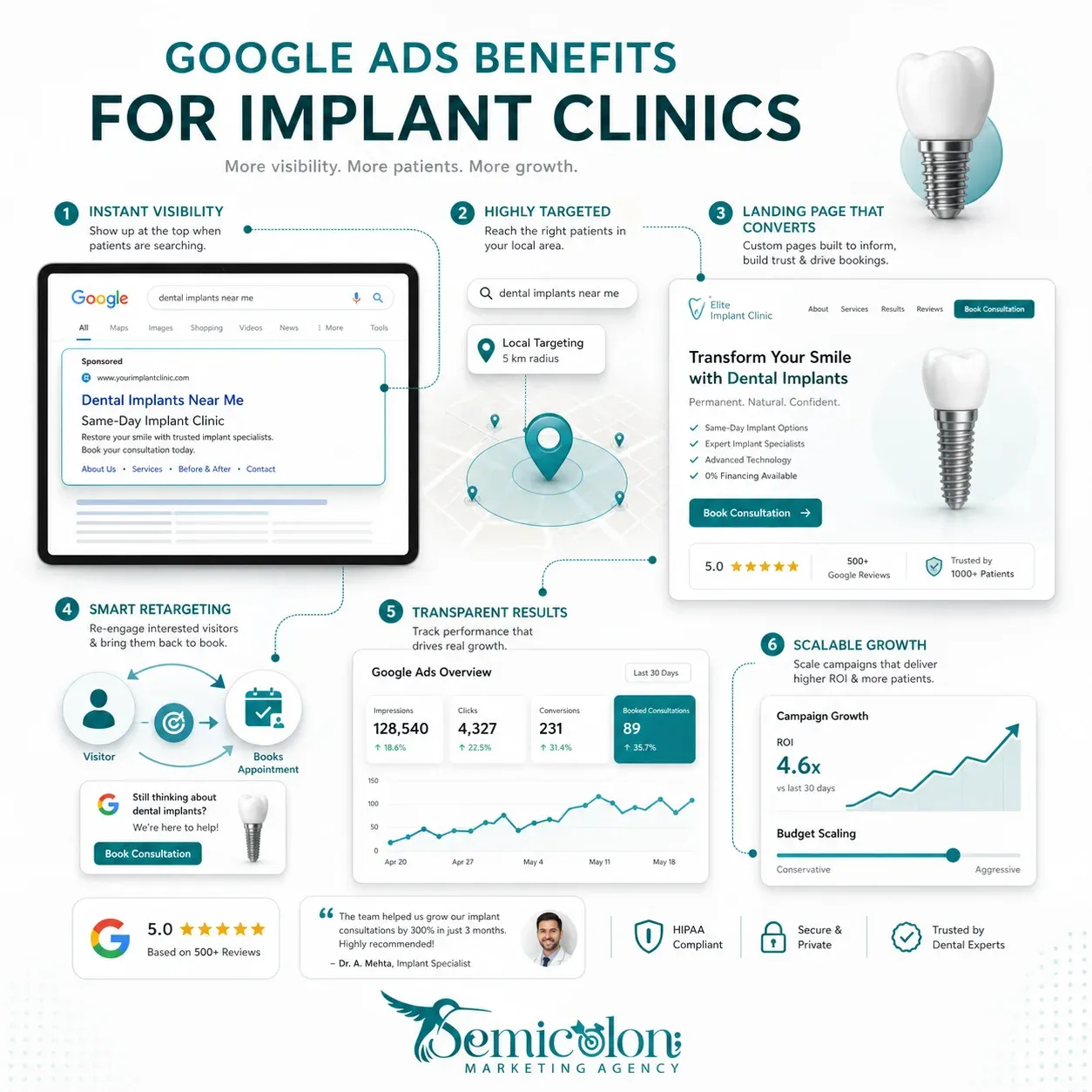
Simply put, Google Ads meet patients where their decisions begin on their screens, in moments of need.
How to Choose the Right Digital Marketing Agency
Not all agencies are created equal, especially when it comes to dental PPC. Choosing the right partner can mean the difference between steady patient flow and wasted budget.
When evaluating agencies, look for:
- Experience in Dental Marketing: Deep understanding of dental terminology, patient psychology, and treatment funnels.
- Transparent Reporting: Access to data showing exactly how your budget performs.
- Integrated Approach: The ability to connect your PPC with SEO, social media, and content marketing.
- Proven Case Studies: Ask for examples showing ROI improvements for other clinics.
A specialized PPC advertising agency understands both Google’s algorithms and the emotional journey of dental patients, combining data science with trust-based messaging.
Why Choose Semicolon Digital Marketing
At Semicolon, we don’t just run ads; we build patient acquisition systems that grow your practice sustainably.
Our Advantages:
- Dedicated expertise in Google Ads for dental clinics and healthcare services.
- Proven results across North America, including a 6.4× ROI increase for Hemlock Dental Clinic.
- Integrated team of SEO, PPC, and creative specialists ensuring message consistency.
- Transparent monthly reports with real-time dashboards tracking CPL, CTR, and ROAS.
- Personalized campaign management, no templates, only data-driven strategies.
Ready to attract more implant patients?
Book a Free Consultation with our specialists and discover how we can help you grow with clarity and confidence.
How to Optimize Google Ads for Dental Implants
Certainly! Here’s the rewritten version with lower perplexity and higher burstiness while maintaining word count and HTML elements:
Optimization is a never-ending process that spots the difference between common and excellent performances in campaigns. Here’s the key to maximizing your results:
- Refine Keywords: Go for the intent-based and very specific searches like “affordable dental implants near me” or “permanent implant dentist in Vancouver.”
- Improve Landing Pages: Make them quick (under 2 seconds), suitable for mobile devices, and aimed at getting conversions. Include before-and-after images and easy-to-find contact buttons.
- Include Trust Elements: Show patient reviews, certifications, and guarantees to increase your credibility.
- Use Smart Bidding: Take advantage of Google’s AI to set your bids automatically according to the conversion probability.
Incorporate Video Marketing:
Post a short video explaining the patient’s most frequent doubts, e.g., “Is it painful to get dental implants?” or “What is the lifespan of a dental implant?”
Not only does this enhance engagement, but it also creates emotional bonds and trust, which are vital for the expensive treatments.
(Video Section Suggestion: A simple 30–45 second explainer embedded on the landing page can increase conversions by up to 80%.)
Managing Expectations and Measuring ROI
Dental implant marketing is not a lightning-fast success story; it’s a long-term commitment. Performance first results during the first months as Google gathers the performance data and fine-tunes ad delivery. Campaigns expertly managed by month three usually reach their highest productivity.
KPIs to monitor:
- Conversion Rate (goal: 10–15%)
- Cost per Lead (CPL: $25–$40)
- Click-Through Rate (CTR: 4–6%)
- Return on Ad Spend (ROAS: 4×–6×)
Slowly but surely, these figures become a given, making it possible for you to estimate the increase and set the budgets up with a sure hand.
External Industry Reference
For broader context on patient acquisition and digital trends in dentistry, refer to trusted resources like the American Dental Association (ADA) or WebMD’s Dental Health Section. These platforms provide data on patient behavior, treatment interest, and healthcare marketing trends without being competitors.
Final Thoughts
In today’s digital-first world, dental implant ads aren’t just optional; they’re essential for clinics that want to grow sustainably. Patients no longer wait to be found; they search, compare, and decide instantly.
A strategic Google Ads for dental implants campaign puts your clinic in front of the right audience, at the right moment, with a message that builds trust. Combine that with precise targeting, optimized landing pages, and transparent reporting, and you’ll transform advertising from an expense into an investment.
At the end of the day, it’s simple:
The clinics that master Google Ads will own the implant market one search, one patient, one smile at a time.


