
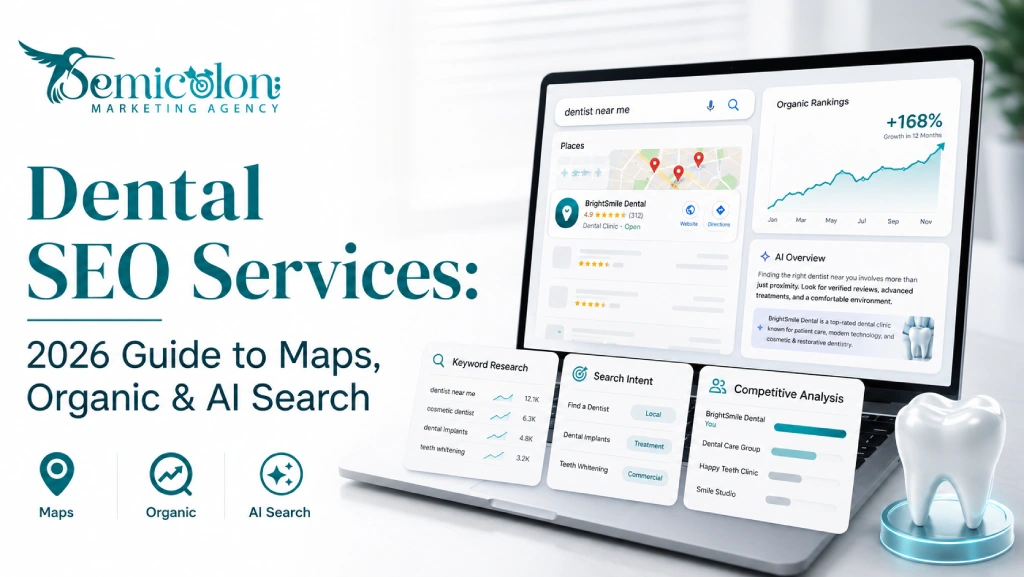
Dental SEO services help dental practices improve their visibility across Google Maps, organic search, and increasingly AI-powered search experiences. Unlike general SEO, dental SEO requires strong local optimization, trustworthy health content, and compliance with Google’s quality standards for healthcare websites.
Industry benchmarks and the best digital marketing agency suggest that many dental practices invest between $1,000 and $3,500 per month in SEO, with initial ranking improvements often appearing within 3–6 months and more meaningful business results developing over 6–12 months, depending on market competition and campaign scope. Because dental patients often have a high lifetime value, a well-executed SEO strategy can deliver a strong long-term return on investment. With patient lifetime values averaging $4,000–$10,000, dental SEO typically delivers 300–1,000% ROI when executed properly.
What Are Dental SEO Services?
Dental SEO is specialized work designed to get your practice ranking in three key areas: Google Maps (the local pack), organic search results, and AI-generated answers. Unlike standard SEO done by an SEO Company in Vancouver, this requires strict YMYL compliance, real dentist E-E-A-T signals, and precise keyword strategies. Generic SEO agencies often overlook important healthcare-specific ranking factors, which can reduce campaign effectiveness.
3 Channels of Dental Search
Dental search operates across three distinct channels, each with different ranking requirements. The Map Pack is essential for capturing high-intent clicks from patients needing immediate care. Organic results are where you build trust through the educational content patients read before booking. By ranking in all three, you can capture 60–70% of patient discovery traffic.
Why Is Dental SEO Harder Than Regular SEO?
Google classifies dental websites as YMYL (Your Money or Your Life). Because your services directly impact a patient’s health and finances, Google holds your site to a much higher standard than e-commerce or entertainment sites. If you fail to demonstrate strong E-E-A-T signals, like verifiable dentist credentials, Google will rank you significantly lower on health-related queries.
Why Generic SEO Agencies Fail with Dentists
Generic agencies often fail because they don’t understand the unique patient journey or healthcare compliance. They treat dental practices like any other local business, overlooking critical factors like HIPAA-compliant analytics, dental-specific directory citations, and the “review velocity” required to dominate the local Map Pack. A specialized agency understands how patients actually search and what Google requires to build trust in your practice.
The 3 Channels of Dental SEO
You can capture 60–70% of new patients by mastering three search channels: the “Map Pack” for quick-click patients who need local care, organic search for those researching treatment options, and AI search for direct, trusted answers. By keeping your Google business profile updated, writing helpful content, and providing clear expert answers, you become the obvious choice no matter how a patient searches.
Channel 1: Map Pack (Local 3-Pack)
The Map Pack is the single highest-ROI channel for general dentistry. Most patients click on the local 3-pack rather than scrolling to organic results. Map Pack ranking is driven by Google Business Profile completeness, review volume (BrightLocal — Local Consumer Survey) and recency, NAP consistency, and proximity to the searcher.
| Ranking Factor | Weight | How to Optimize |
|---|---|---|
| Google Business Profile completeness | High | Complete every field, add photos, use Q&A |
| Review volume + recency | Very High | Generate 5+ reviews per month, respond to all |
| NAP consistency | High | Ensure identical NAP across 50+ directories |
| Proximity to searcher | High | Create location-specific landing pages |
| Categories selected | Medium | Primary + secondary categories |
| Posts (GBP weekly) | Medium | Post weekly updates |
| Photos (regular updates) | Medium | Add monthly fresh photos |
Channel 2: Organic Search Results
Organic search matters more for specialty and high-ticket services where patients research extensively before booking. Ranking factors include content depth, building authority backlinks, technical SEO, and user engagement signals.
| Ranking Factor | Weight |
|---|---|
| Content depth + topical authority | Very High |
| Backlinks from authoritative sites | Very High |
| Technical SEO (Core Web Vitals) | High |
| On-page optimization | High |
| User engagement signals | High |
| E-E-A-T signals | High (YMYL) |
| Schema markup | Medium |
Channel 3: AI Search & AEO/GEO
AI search engines now influence 30–40% of dental searches. When AI Overviews appear, traditional organic CTR drops from 15% to 8%. Optimizing for AI requires “Direct Answer Blocks,” schema markup, real expert authorship, and citable data points. GEO (Generative Engine Optimization) structures content so your practice is accurately surfaced in AI-driven search experiences.
In Google Search Central — Quality Rater Guideline, AI search optimization goes beyond adding schema markup. Large language models tend to reference pages that answer questions directly, demonstrate clear expertise, and cite trustworthy sources. Dental practices should structure treatment pages around real patient questions, include concise answer summaries near the top of each section, and keep clinical information regularly updated. These practices improve visibility not only in Google AI Overviews but also in AI assistants such as ChatGPT and Perplexity, where patients increasingly begin their research before choosing a provider.
How Does Dental SEO Work? (The 4 Pillars)
Effective dental SEO operates through four interconnected pillars: Technical SEO (site speed, mobile, crawlability), On-Page SEO (content, service pages, schema), Local SEO (GBP, reviews, citations), and Off-Page SEO (backlinks, mentions, authority). The exact ratio depends on your practice stage.
| Practice Stage | Technical | On-Page | Local | Off-Page |
|---|---|---|---|---|
| New Practice | 25% | 30% | 35% | 10% |
| Growing Practice | 15% | 30% | 30% | 25% |
| Established | 10% | 25% | 30% | 35% |
| Multi-Location/DSO | 15% | 30% | 25% | 30% |
How to Optimize Your Google Business Profile for Dental SEO
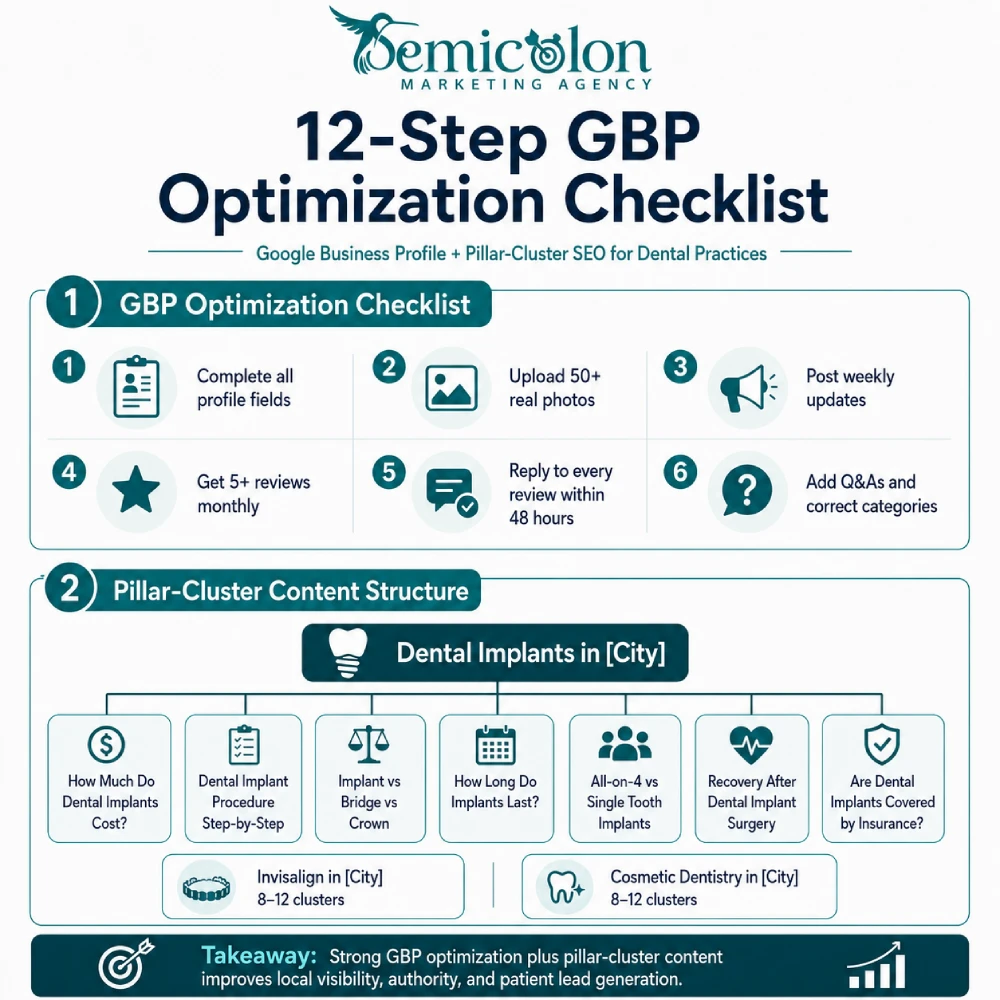
Google Business Profile is the single highest-ROI dental SEO asset; it controls 60–70% of Map Pack ranking. Critical optimizations include: complete every field, upload 50+ real photos, post weekly updates, generate 5+ reviews monthly with diverse keywords, respond to every review within 48 hours, and verify GBP categories include both primary and secondary categories.
12-Step GBP Optimization Checklist
Complete every field, including services, description, hours, and attributes mentioned in Google Business Profile Help. Upload 50+ real photos of your team, facility, and procedures. Post weekly updates about services, offers, or practice news. Generate 5+ reviews monthly and respond to every review within 48 hours. Add proactive Q&As covering common patient questions. Verify categories include both “Dentist” and specific services like “Cosmetic Dentist” or “Dental Implants Provider.”
One of the most effective content strategies for dental SEO is the pillar-cluster model.
Pillar-Cluster:
🏛️ PILLAR: Dental Implants in [City]
│
├── 📄 Cluster: How Much Do Dental Implants Cost?
├── 📄 Cluster: Dental Implant Procedure Step-by-Step
├── 📄 Cluster: Implant vs Bridge vs Crown
├── 📄 Cluster: How Long Do Implants Last?
├── 📄 Cluster: All-on-4 vs Single Tooth Implants
├── 📄 Cluster: Recovery After Dental Implant Surgery
└── 📄 Cluster: Are Dental Implants Covered by Insurance?
🏛️ PILLAR: Invisalign in [City]
↓ (8-12 clusters)
🏛️ PILLAR: Cosmetic Dentistry in [City]
↓ (8-12 clusters)
How Do You Build a Dental Pillar-Cluster Content Strategy?
A dental Pillar-Cluster strategy organizes content into cornerstone hubs (one comprehensive page per major service) supported by cluster articles (8–15 blog posts per service exploring subtopics). For example, the Dental Implants pillar links to clusters on cost, timeline, implant vs bridge, and procedure details. This signals topical authority to Google and matches how patients actually search.
How to Choose Your Cornerstone Hubs
Select 2–4 high-value services as your growth engines: implants, Invisalign, cosmetic dentistry, or emergency care. Build comprehensive pillar pages for each, then create 8–15 cluster articles answering specific patient questions about that service.
Internal linking plays an equally important role in a pillar-cluster strategy. Every cluster article should naturally link back to its primary service page while the pillar page links to each supporting article. This structure helps search engines understand topical relationships, distributes authority across related pages, and allows patients to continue exploring treatment information without leaving the website.
What Are E-E-A-T Signals for Dental SEO? (YMYL Compliance)
Dental websites are classified as Google Search Central YMYL, requiring higher quality standards. Strong E-E-A-T signals help demonstrate expertise, authority, and trustworthiness, making them essential for achieving sustainable rankings in health-related search results.
- Use real dentist author bios with professional photos, qualifications, and credentials (DDS/DMD) to demonstrate expertise.
- Create a detailed About Us page featuring your dental team, real images, and professional backgrounds to strengthen trust.
- Link to verified professional profiles such as ADA memberships, provincial or state dental boards, and other recognized organizations to reinforce authority.
- Cite authoritative medical sources like the ADA, CDC, and ADHA whenever referencing clinical information.
- Include editorial reviews by licensed dentists (for example, “Reviewed by Dr. Smith”) to improve YMYL compliance.
- Publish patient testimonials only with written consent and ensure they comply with HIPAA or other applicable privacy regulations.
- Secure your website with HTTPS and provide clear Privacy Policy and Terms pages to build user confidence and meet Google’s trust requirements.
Beyond individual trust signals, consistency across the entire website matters. Author information, review dates, contact details, treatment descriptions, and professional credentials should remain accurate and regularly updated. Demonstrating ongoing clinical review and publishing evidence-based content reinforces Google’s confidence that the practice provides reliable healthcare information.
How Do Independent Practices Compete with DSOs in SEO?
DSOs have larger SEO budgets and dedicated marketing teams, but independent practices have advantages: hyper-local relevance, real personal stories, faster decision-making, and authentic dentist authorship. Winning strategies include: dominating hyper-local keywords, building deep specialty content, leveraging real dentist personality and expertise, and focusing on review velocity.
Independent practices also benefit from highlighting their connection to the local community. Publishing neighbourhood-specific content, participating in local events, showcasing real patient success stories with consent, and building partnerships with nearby businesses create relevance that large corporate dental organizations often struggle to replicate. These local trust signals can significantly improve both Map Pack visibility (according to Search Engine Journal) and patient confidence.
How Much Do Dental SEO Services Cost in 2026?
Most dental practices invest between 1,000 and 3,500 per month for a comprehensive SEO strategy. Dental SEO pricing varies based on the size of the practice, competition, and the scope of services.
Solo practices typically require a basic local SEO package, while growing clinics often benefit from comprehensive campaigns that include content creation, link building, and AI search optimization.
Multi-location practices and DSOs usually need enterprise-level strategies with advanced technical SEO, digital PR, and ongoing performance monitoring. Extremely low-cost SEO services often rely on automated tactics and may fail to deliver sustainable results.
What’s Included by Tier:
| Service | Entry | Growth | Enterprise |
| GBP optimization | ✅ | ✅ | ✅ |
| Citation building | Limited | ✅ | ✅ |
| Content (articles/month) | 1-2 | 4-6 | 8-15 |
| Link building (per month) | 0 | 3-8 | 10-25 |
| Technical audits | Once | Quarterly | Monthly |
| AEO/AI optimization | ❌ | ✅ | ✅ |
| Schema markup | Basic | Advanced | Custom |
| Reporting | Basic | Detailed | Real-time dashboard |
| Account manager | Shared | Dedicated | Dedicated team |
How Long Does Dental SEO Take to Show Results?
Dental SEO follows a predictable timeline:
- Months 1–2 see initial setup with no visible ranking changes.
- Months 3–4 show first ranking improvements for low-competition keywords. Months 5–6 deliver meaningful Map Pack rankings and first patients from organic search.
- Months 7–12 build into a stable patient flow of 8–15 new patients per month.
- Full ROI compounds over 12–24 months.
| Phase | Duration | Activities | Expected Results |
| Foundation | Months 1-2 | Audit, GBP, technical fixes | No visible movement |
| Early Wins | Months 3-4 | Content + citations | Long-tail rankings appear |
| Acceleration | Months 5-6 | Link building + AEO | Map Pack movement, first patients |
| Patient Flow | Months 7-12 | Optimization + scaling | 8-15 new patients/month |
| Compounding | Months 12-24+ | Authority growth | 15-30+ patients/month |
HIPAA + PIPEDA Compliance in Dental SEO
As mentioned by the American Dental Association (ADA) — Marketing/Advertising Guidelines, Dental SEO must comply with patient privacy regulations: HIPAA in the US and PIPEDA in Canada (Office of the Privacy Commissioner of Canada (PIPEDA). SEO-specific compliance requirements include HIPAA-compliant analytics, no IP/PII in URLs, secure form handling, encrypted call tracking, and written consent for testimonials and before/after photos. Canadian practices must also follow provincial dental board advertising guidelines.
What Return Can Dental Practices Expect from SEO?
The return on investment from dental SEO varies based on your location, competition, treatment mix, and the quality of your strategy. Practices offering high-value services such as dental implants, Invisalign, or cosmetic dentistry often see a greater return because each new patient can represent significant long-term revenue.
Rather than delivering immediate results in Pediatric Dental Marketing, SEO compounds over time. As your website earns authority, your Google Business Profile gains visibility, and more treatment pages rank for relevant searches, the cost of acquiring new patients typically decreases while organic traffic continues to grow.
Although no agency can guarantee a specific ROI, industry studies consistently show that a well-executed dental SEO campaign can outperform many paid advertising channels over the long term by generating sustainable, high-intent patient leads.
Common Dental SEO Mistakes (And How to Fix Them)
Even well-designed dental websites can struggle to rank if they overlook key SEO fundamentals. Avoiding these common mistakes can significantly improve your visibility in Google Maps, organic search, and AI-powered search results.
- Using a single service page for every treatment instead of creating dedicated pages for services like dental implants, Invisalign, cosmetic dentistry, and emergency dental care.
- Neglecting your Google Business Profile by leaving information incomplete, failing to update photos, or responding inconsistently to patient reviews.
- Publishing thin or generic content that doesn’t answer real patient questions or demonstrate your clinical expertise.
- Ignoring AI search optimization (AEO/GEO), which reduces your chances of appearing in AI Overviews and other AI-generated search experiences.
- Missing structured data (Schema Markup), makes it harder for search engines to understand your services, reviews, FAQs, and business information.
- Building few or low-quality backlinks limits your website’s authority and ability to compete for valuable treatment-related keywords.
- Hiring a general SEO agency without dental experience results in strategies that overlook YMYL requirements, E-E-A-T signals, and healthcare-specific best practices.
- Expecting immediate results and stopping too early. Dental SEO is a long-term investment, and most practices begin seeing meaningful, sustainable growth after several months of consistent optimization.
Example of a Successful Dental SEO Campaign
Successful dental SEO campaigns are built through continuous optimization rather than one-time improvements. Regular content updates, technical audits, review generation, and ongoing refinement of local search signals help practices maintain rankings as competitors and search algorithms evolve. Consistency is often the difference between short-term ranking gains and sustainable patient growth.
A multi-location dental web design practice improved its Google Business Profile, published treatment-specific service pages, and implemented structured data over several months. As its local visibility increased, the practice saw stronger rankings for high-intent treatment keywords and a steady increase in organic appointment enquiries.
Why Choose Semicolon for Dental SEO Services?
Building a dental SEO system by an SEO Strategist at Semicolon that ranks across Map Pack, organic, and AI search (Search Engine Land — AEO/AI Search) takes specialized dental expertise, YMYL-compliant content, and consistent execution over 6–12 months. For practices seeking a partner that understands the unique dynamics of dental patient acquisition, Semicolon offers specialized dental SEO services designed to deliver measurable patient growth and sustainable ROI in today’s competitive search landscape. Want to know why your dental marketing practice isn’t ranking in Google Maps or organic search? Request a Dental SEO Audit from Semicolon and receive a tailored growth plan based on your website, competitors, and local market.
FAQs
How much do dental SEO services cost?
Dental SEO services cost $500–$10,000+ per month in 2026. Most growing practices invest $1,000–$3,500/month.
How long does dental SEO take to work?
First ranking improvements appear in months 3–4, meaningful Map Pack rankings in months 5–6, and stable patient flow in months 7–12. Full ROI compounds over 12–24 months.
Is dental SEO worth it?
Yes, dental SEO typically delivers 300–1,000% ROI when executed properly. With patient lifetime values of $4,000–$10,000, even 5 new patients/month at $2,000/month investment generates 1,150% ROI .
What’s the difference between dental SEO and Google Ads for dentists?
Dental SEO builds long-term organic visibility (results in 6–12 months, compounds over time). Google Ads delivers immediate visibility (results in 24–48 hours but stops when the budget stops). Most successful practices run both.
What’s most important: Map Pack or organic SEO for dentists?
Map Pack is more important for general dentistry, most patients click on the local 3-pack.
How do reviews affect dental SEO rankings?
Reviews are one of the strongest ranking factors. Google evaluates volume, recency, velocity, responses, and keyword content. Practices with 100+ reviews and 4.7+ rating rank significantly higher.
Should dental practices optimize for AI search?
Yes, AI search now influences 30–40% of dental queries. Optimizing for AEO requires Direct Answer Blocks, real expert authorship, schema markup(Schema.org — Dentist), and citable data.


