
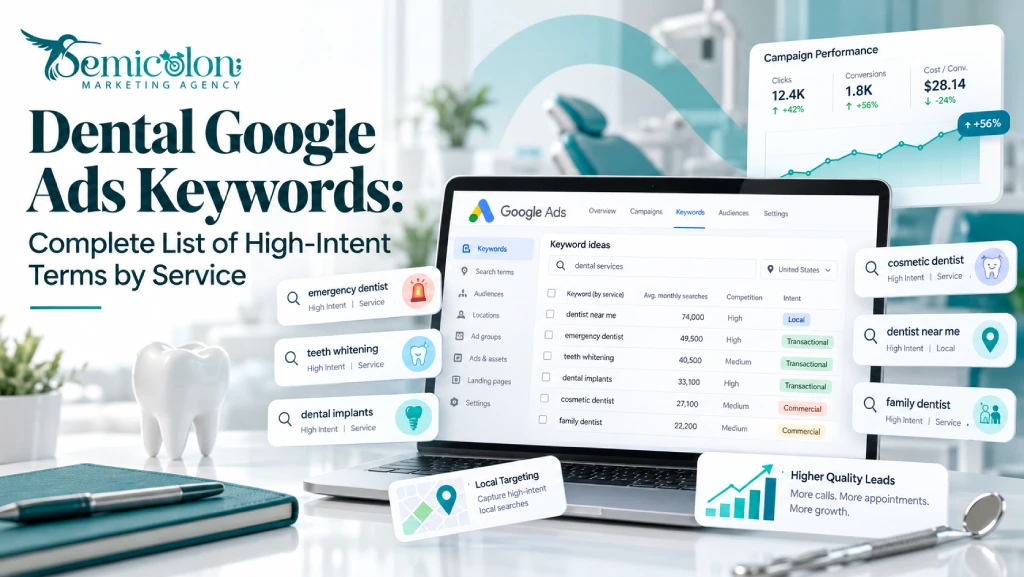
The best dental Google Ads keywords combine clear patient intent, specific services, and local searches. Keywords like “emergency dentist near me,” “dental implants cost,” and “Invisalign provider near me” can help dental practices reach patients actively seeking care.
Broad terms like “dentist” or “teeth” may attract less relevant clicks. To choose better keywords, consider the service, location, cost per click (CPC), and the patient’s next step.
This guide covers dental Google Ads keywords, Google Ads Help, negative keywords, costs, and campaign examples to help you make better advertising decisions.
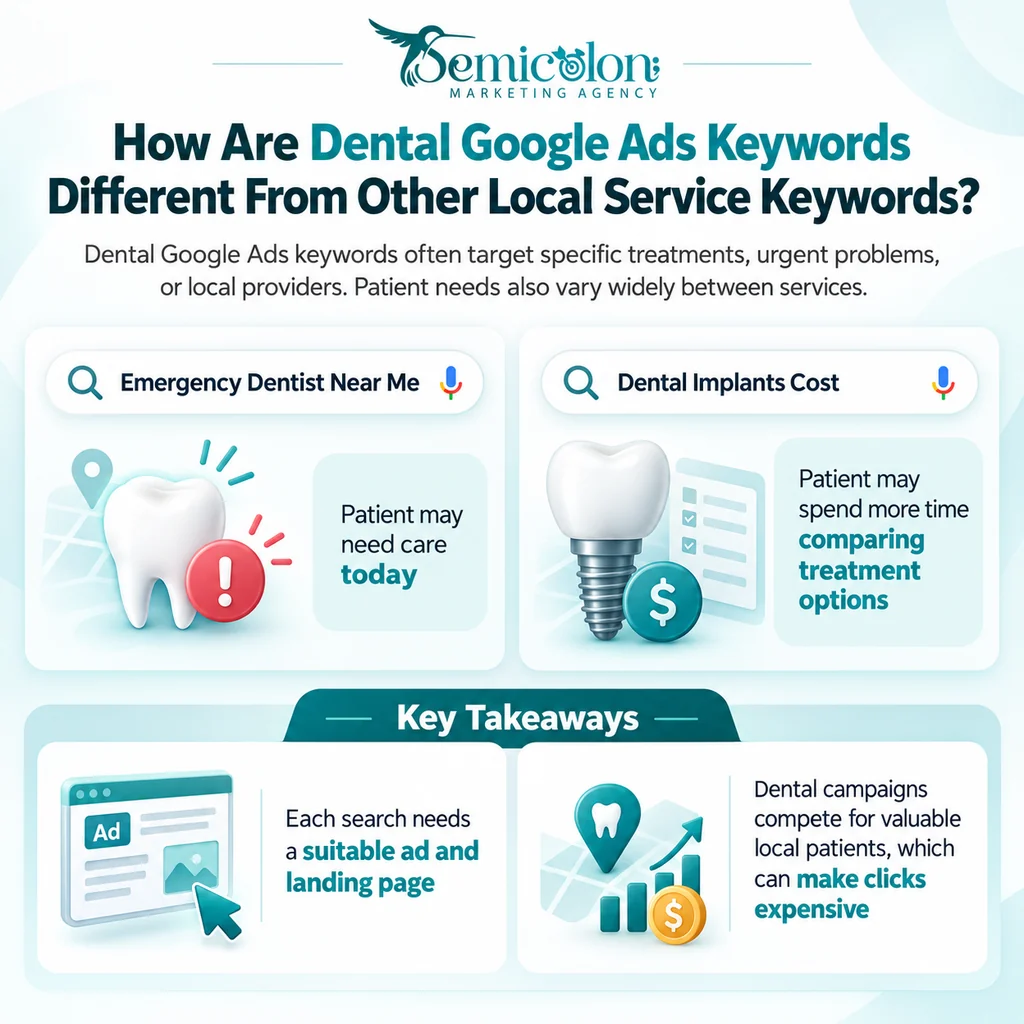
How Are Dental Google Ads Keywords Different From Other Local Service Keywords?
Dental Google Ads keywords often target specific treatments, urgent problems, or local providers. Patient needs also vary widely between services.
For example, someone searching for “emergency dentist near me” may need care today. Someone searching for “dental implants cost” may spend more time comparing treatment options.
This difference matters because each search needs a suitable ad and landing page. Dental campaigns also compete for valuable local patients, which can make clicks expensive.
What Are the Best Dental Google Ads Keywords by Service?
The best keywords depend on the dental treatments your practice offers. Emergency dentistry, implants, cosmetic care, Invisalign, and general dentistry each attract different searches.
1. Emergency Dental Keywords
Emergency dental keywords target people who need quick dental care. These searches often show urgent intent.
| Keyword | Intent | Starting Match Type |
| emergency dentist near me | Urgent | Exact / Phrase |
| 24 hour dentist | Urgent | Exact |
| same day dentist | Urgent | Phrase |
| broken tooth repair | High | Phrase |
| tooth pain emergency | High | Phrase |
| weekend dentist | Urgent | Phrase |
| emergency tooth extraction | High | Phrase |
| walk in dentist | High | Phrase |
| after hours dentist | Urgent | Phrase |
| dental abscess emergency | High | Phrase |
Only target services and opening hours your clinic actually offers. Emergency ads should lead to a page with clear contact details and appointment information.
2. Dental Implant Keywords
Dental implant keywords target patients looking to replace missing teeth. Some searches show booking intent, while others focus on treatment costs.
| Keyword | Intent | Starting Match Type |
| dental implants near me | Local / High | Exact / Phrase |
| dental implants cost | Comparison | Phrase |
| dental implant dentist | High | Phrase |
| single tooth implant cost | Comparison | Phrase |
| full mouth dental implants | High | Phrase |
| All-on-4 dental implants | High | Phrase |
| All-on-4 cost | Comparison | Phrase |
| implant supported dentures | High | Phrase |
| affordable dental implants | Comparison | Phrase |
| dental implant financing | Decision | Phrase |
Cost searches should lead to a useful pricing page. Provider searches should lead to a dental implant service page.
Our guide to Dental Implant Ads explores how implant campaigns can connect treatment searches with suitable ads and landing pages.
3. Cosmetic Dentistry Keywords
Cosmetic dentistry keywords help practices reach people interested in improving their smile.
| Keyword | Intent | Starting Match Type |
| cosmetic dentist near me | Local / High | Exact / Phrase |
| veneers near me | High | Phrase |
| porcelain veneers cost | Comparison | Phrase |
| teeth whitening dentist | High | Phrase |
| professional teeth whitening | High | Phrase |
| dental bonding cost | Comparison | Phrase |
| smile makeover dentist | High | Phrase |
| composite veneers | Research / Comparison | Phrase |
| cosmetic dentistry near me | Local / High | Phrase |
Keep veneers, whitening, and bonding in separate keyword groups when they need different landing pages.
4. Invisalign and Orthodontic Keywords
Invisalign keywords target patients who want straighter teeth or want to compare treatment options.
| Keyword | Intent | Starting Match Type |
| Invisalign near me | Local / High | Exact / Phrase |
| Invisalign provider near me | High | Phrase |
| Invisalign dentist | High | Phrase |
| Invisalign cost | Comparison | Phrase |
| Invisalign cost near me | Comparison / Local | Phrase |
| clear aligners near me | High | Phrase |
| braces cost | Comparison | Phrase |
| orthodontist near me | Local / High | Exact / Phrase |
| Invisalign consultation | Decision | Phrase |
Patients searching for prices need cost information. Those looking for a provider need treatment details, location, and a clear way to book an appointment.
5. General Dentistry and Near Me Keywords
General dentistry keywords can help clinics attract patients looking for routine dental care.
| Keyword | Intent | Starting Match Type |
| dentist near me | Local | Exact / Phrase |
| family dentist near me | Local / High | Phrase |
| dental clinic near me | Local | Phrase |
| dentist accepting new patients | Decision | Exact / Phrase |
| general dentist near me | Local | Phrase |
| dental cleaning near me | High | Phrase |
| dental checkup near me | High | Phrase |
| dentist open Saturday | Local / High | Phrase |
| local dentist | Local | Phrase |
These terms can attract different patient needs. Use location targeting and relevant ads to reach people within your service area.
Which Keywords Work for Specialty Dental Practices?
Specialty practices need keywords that match their treatments. Pediatric dentistry, root canals, gum care, and oral surgery attract different patients.
Pediatric Dental Keywords
Parents often search for “pediatric dentist near me” or “kids dentist near me.” Use a landing page that explains children’s dental services and makes booking easy. Our Pediatric Dental Marketing guide offers more ideas.
Root Canal and Endodontic Keywords
Keywords like “root canal specialist” and “endodontist near me” can reach patients looking for specific treatment. Send them to a page that explains the procedure and appointment options.
Periodontal Keywords
Searches such as “periodontist near me” and “gum disease treatment” help reach patients looking for gum care. Your landing page should explain the available treatments.
Oral Surgery Keywords
Keywords like “oral surgeon near me” and “wisdom tooth removal” can attract patients seeking surgical care. Match each keyword with the service your practice offers.
How Do Dental Google Ads Keywords Change Across the Buyer Journey?
Dental patients search differently as they move from research to booking. Each stage needs a different message and landing page.
| Buyer Stage | Keyword Example | Intent | Suggested Landing Page |
| Awareness | what causes tooth pain | Informational | Educational article |
| Consideration | dental implants vs bridge | Comparison | Treatment comparison |
| Cost research | dental implants cost | Commercial | Cost guide |
| Decision | dentist accepting new patients | Transactional | Appointment page |
| Urgent decision | emergency dentist near me | Transactional | Emergency service page |
Not every search leads to an appointment. Focus your budget on keywords that match your goals and bring the right patients to your practice.
For example, “dental implants near me” and “dental implants cost” may need different ad groups because the searches show different needs. Understanding search intent helps dentists create more relevant ads. Resources from Think with Google offer insights into how people search, compare options, and make decisions online.
What Negative Keywords Should Dental Practices Use?
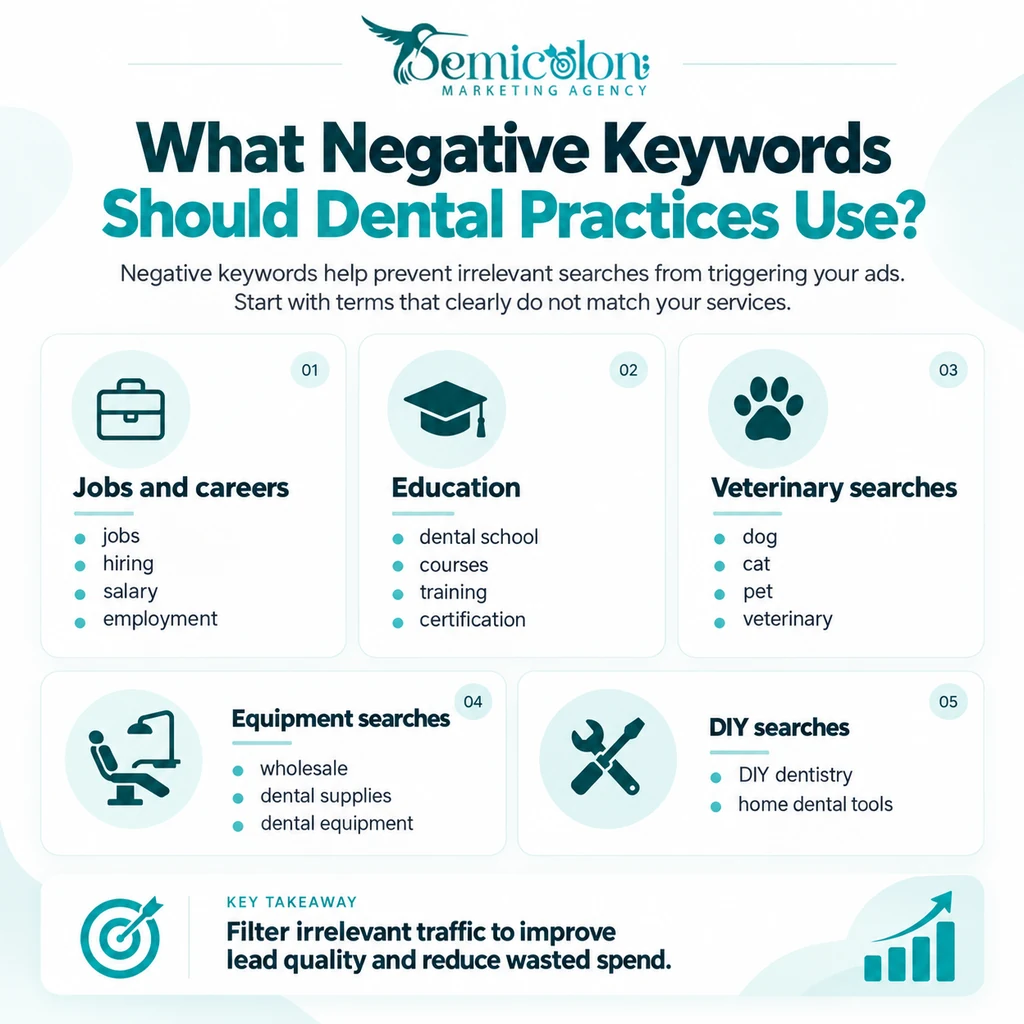
Negative keywords help prevent irrelevant searches from triggering your ads. Start with terms that clearly do not match your services.
Common examples include:
- Jobs and careers: jobs, hiring, salary, employment
- Education: dental school, courses, training, certification
- Veterinary searches: dog, cat, pet, veterinary
- Equipment searches: wholesale, dental supplies, dental equipment
- DIY searches: DIY dentistry, home dental tools
Do not automatically exclude “free,” “cheap,” or “how to.” These searches may still matter for some campaigns.
Service-Specific Negative Keywords
Different dental campaigns may need different exclusions.
| Campaign | Negative Keyword Candidates | Why |
| Dental implants | implant training, implant course | Education searches |
| Teeth whitening | whitening strips, DIY whitening kit | Product searches |
| Invisalign | aligner manufacturing, DIY aligners | Unrelated searches |
| Pediatric dentistry | veterinary dentist, pet dental care | Animal care searches |
Review these terms before adding them. A negative keyword can also block a useful search if you choose it too broadly.
How Often Should You Review Negative Keywords?
Review search terms regularly, especially when you launch a new campaign. Google’s Search Terms Report helps you identify irrelevant searches and improve your keyword list. It does not display every low-volume search.
Which Google Ads Match Type Should Dentists Use?
Google Ads offers Exact, Phrase, and Broad Match. The best option depends on your goals, bidding strategy, and conversion data.
| Match Type | Main Benefit | What to Consider |
| Exact | More control over search meaning | May reach fewer searches |
| Phrase | Reaches more related searches | Review search terms |
| Broad | Wider reach | Use Smart Bidding and reliable tracking |
Exact Match does not require identical wording. Google can match searches with the same meaning or intent.
Broad Match can also work for dental campaigns, but it needs careful testing. Google explains the differences in its keyword matching guide.
How Much Do Dental Google Ads Keywords Cost in 2026?
Dental Google Ads CPC depends on location, competition, keyword intent, and bidding strategy. There is no fixed price for each dental keyword.
WordStream Industry Benchmarks 2026 US Dentists & Dental Services reports:
- Average CPC: $8.00
- Average CTR: 5.66%
- Average conversion rate: 10.67%
- Average cost per lead: $72.97
These figures represent US industry averages, not guaranteed campaign results.
How Can You Compare CPC Across Dental Services?
CPC varies by service, location, and competition. Emergency and implant searches may cost more than routine dental searches, but higher CPC does not always mean better results.
Use Google Keyword Planner to compare local CPC estimates. Then check your cost per qualified lead and booked appointment to see which keywords are worth keeping.
How Do You Choose the Right Dental Google Ads Keywords?
Choose keywords based on three factors: the services you offer, your advertising budget, and the value of the patients you want to reach.
Dental Keyword Decision Matrix
| Practice Goal | Keyword Example | Priority | Best Landing Page |
| Book urgent patients | emergency dentist near me | High | Emergency booking |
| Attract implant patients | dental implants near me | High | Implant service |
| Reach price-conscious patients | dental implants cost | Medium–High | Pricing guide |
| Grow cosmetic services | veneers near me | High | Veneers service |
| Increase routine appointments | dental cleaning near me | Medium | Cleaning service |
| Attract orthodontic patients | Invisalign provider near me | High | Invisalign consultation |
You can also explore The 6 Best PPC Keyword Tools for more research options.
What Are the Most Common Dental Google Ads Keyword Mistakes?
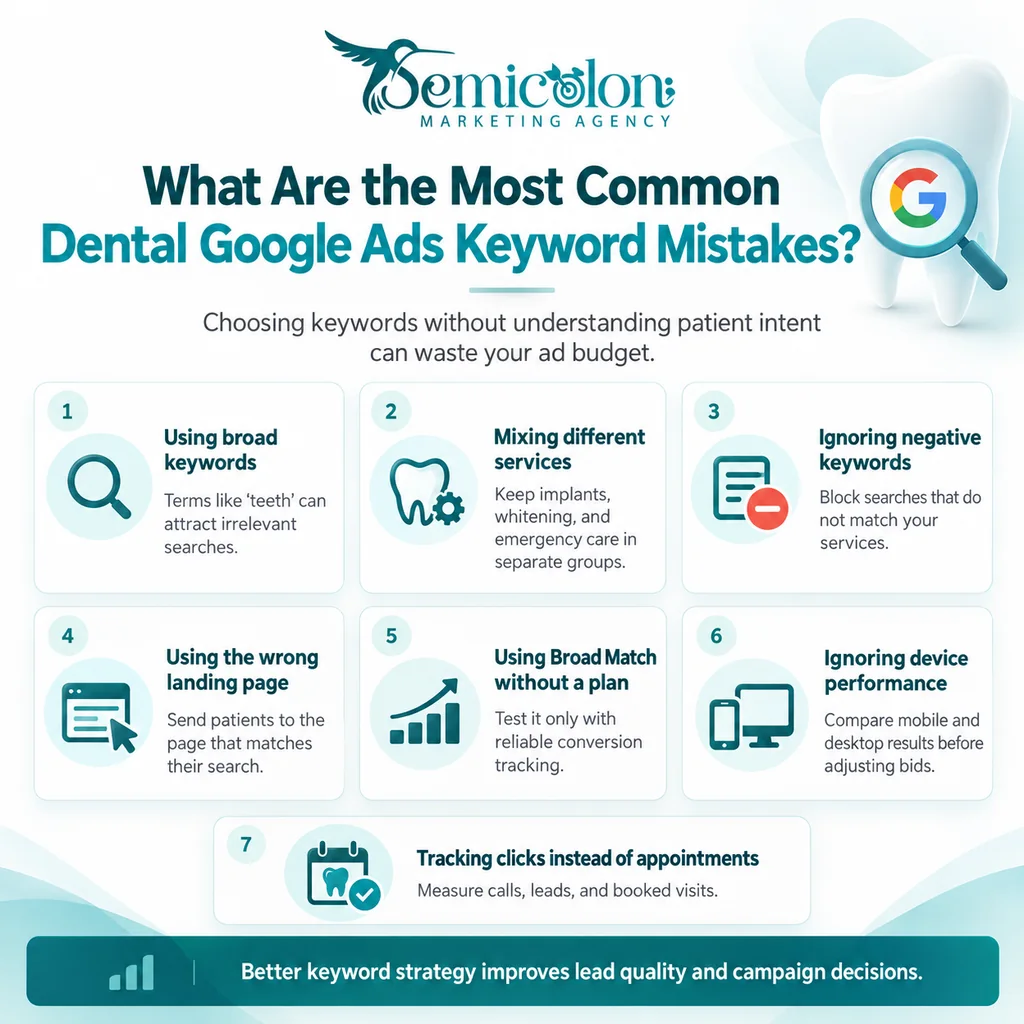
Choosing keywords without understanding patient intent can waste your ad budget. Here are common mistakes to avoid:
- Using broad keywords: Terms like “teeth” may attract irrelevant searches.
- Mixing different services: Keep implants, whitening, and emergency care in separate groups.
- Ignoring negative keywords: Block searches that do not match your services.
- Using the wrong landing page: Send patients to the page that matches their search.
- Using Broad Match without a plan: Test it with reliable conversion tracking.
- Ignoring device performance: Compare mobile and desktop results before adjusting bids.
- Tracking clicks instead of appointments: Measure calls, leads, and booked visits.
Our Google Ads Conversion Tracking guide explains how to measure useful actions and improve campaign decisions.
For more insights into paid search strategies and common PPC challenges, Search Engine Journal offers practical guides on improving campaign performance.
Ready-to-Use Dental Google Ads Keyword Template
A simple campaign structure helps you keep services, keywords, and landing pages organized. Here is a starting plan with five campaigns and 15 ad groups.
| Campaign | Suggested Ad Groups |
| Emergency Dentistry | Emergency Dentist, Tooth Pain, Emergency Extraction |
| Dental Implants | Implant Dentist, Implant Cost, Full-Mouth Implants |
| Cosmetic Dentistry | Veneers, Whitening, Dental Bonding |
| Invisalign | Invisalign Provider, Invisalign Cost, Clear Aligners |
| General Dentistry | Family Dentist, Dental Cleaning, New Patients |
Example: Dental Implant Campaign
Create separate ad groups for implant services, pricing, and full-mouth implants. Use “dental implants near me” as an Exact Match starting keyword and “dental implants cost” as Phrase Match. Send each group to a relevant landing page and review search terms regularly.
Start with a small, focused keyword list. Review search terms regularly and add negative keywords such as “implant training” or “dental implant course” when they bring irrelevant traffic.
How Do Voice Search and AI Affect Dental Keywords in 2026?
Patients may search using natural questions like “Where can I find an emergency dentist open today?” or “How much do dental implants cost?”
You do not need a separate keyword for every question. Focus on patient intent and relevant landing pages.
Google’s AI Max for Search can help ads reach related searches beyond existing keywords. Review search terms, landing pages, and conversions to see whether this traffic brings qualified patients.
How Can a Dental Google Ads Agency Help?
A dental PPC agency can help practices choose keywords, organize campaigns, improve landing pages, and measure patient inquiries.
When comparing a Google Ads Agency, look at how the team tracks qualified leads and booked appointments.
A digital marketing agency for your dental practice should understand your services, location, budget, and patient goals.
A Dental Clinic for Google Ads strategy also needs more than a keyword list. Relevant ads, landing pages, and conversion tracking all matter.
Make Better Use of Your Dental Google Ads Budget
The right dental Google Ads keywords can help your practice reach people who need your services. Focus on patient intent, relevant landing pages, and accurate conversion tracking.
If you are looking for the best digital marketing agency, at Semicolon Digital Marketing Agency, we help dental practices review their campaigns and understand where they can improve. If you want a clearer view of your keyword choices, ad spending, and patient inquiries, exploring our dental PPC services can be a useful next step.
FAQs
What are the best dental Google Ads keywords?
Keywords with clear service and local intent are a good starting point. Examples include “emergency dentist near me,” “dental implants near me,” and “Invisalign provider near me.”
How much do dental Google Ads keywords cost?
Costs vary by keyword and location. WordStream reported an average US dental CPC of $8.00 in its 2026 benchmark.
How many keywords should a dental practice target?
There is no fixed number. Start with focused groups for your main services and expand based on results.
What negative keywords should dentists use?
Jobs, training, veterinary, and wholesale equipment searches may be irrelevant. Review your search terms before adding exclusions.
Should dentists use Broad Match?
Broad Match can work with Smart Bidding and reliable conversion tracking. Test it and review performance regularly.
What is the difference between dental SEO and Google Ads keywords?
Dental SEO can target research and booking searches over time. Google Ads uses paid placements, so keyword intent and conversion tracking matter for managing costs.
How long does it take to see results from dental Google Ads?
Ads can start receiving clicks after launch, but useful conversion data takes time. Review leads, appointments, and costs before making major decisions.
Can I advertise several dental specialties at once?
Yes. Keep services in separate campaigns or focused ad groups when they need different ads, budgets, or landing pages.


